Newest station on the island
Registered in 2021, opened March 2022, and run under a partnership between Kunigami Village and Keio University's graduate school of media design. It's a working experiment as much as a shop.
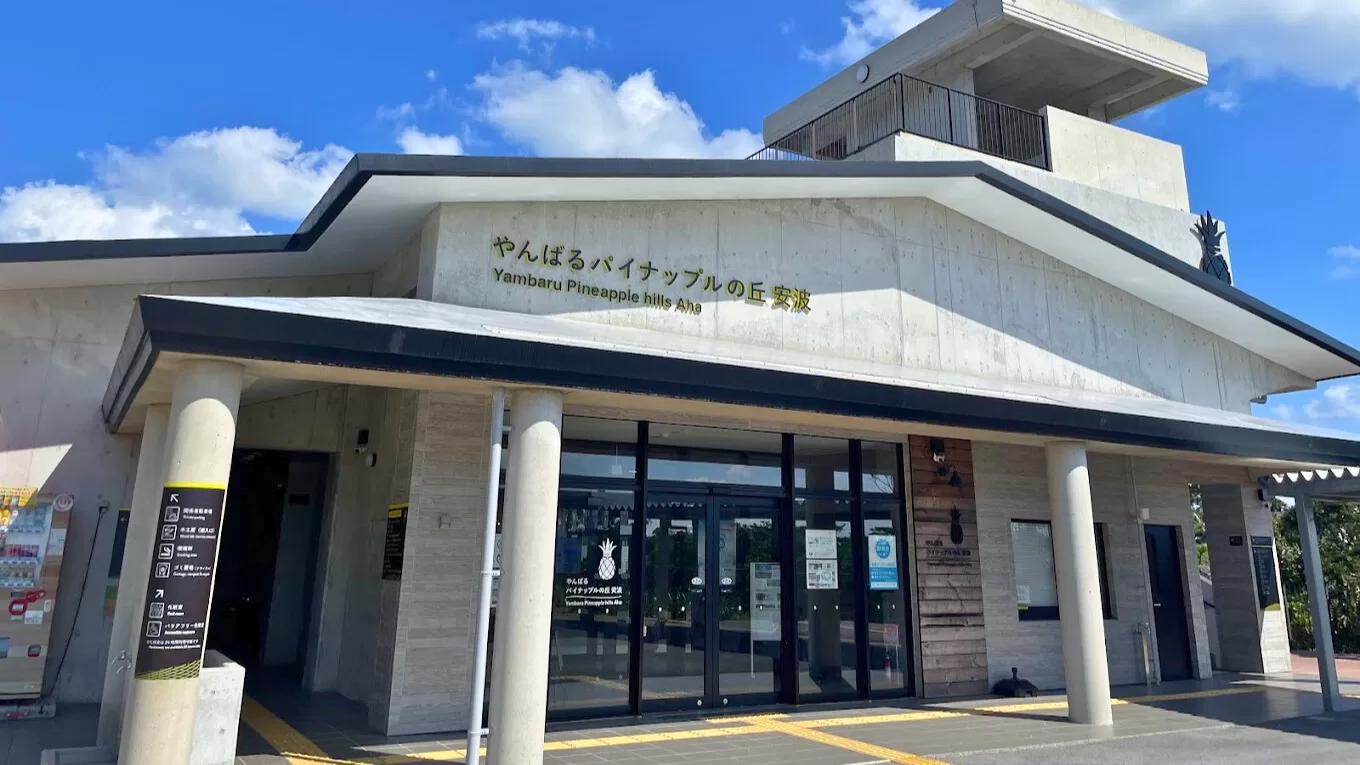
Okinawa's newest roadside station, built with a university on the coast nobody drives, where the fruit that can't be sold becomes cake, and then becomes pork.
Registered in 2021, opened March 2022, and run under a partnership between Kunigami Village and Keio University's graduate school of media design. It's a working experiment as much as a shop.
Pineapples that fail grading become cake and confiture; what's left feeds pigs, which come back as paiton pork on the menu. The loop closes on one site.
The rooftop swing, the forest trail and the observation building are a paid zone: ¥340 for adults, ¥170 for primary-school children. The main building's viewing deck is free.
The east coast of northern Okinawa is the part that gets driven past. This station was built to change that, and it does it in the least likely way: by treating substandard pineapples as a design problem.
The idea
Okinawan pineapple that fails grading (bruised by a typhoon, wrong shape, wrong size) used to be a loss. Here it becomes something else, twice.
Step one
Cake, ¥330A Taiwanese-style pineapple cake made with the local N67-10 variety. Limited numbers; when the shop sells out, the café gets the rest.Step two
Paiton porkWhat can't be baked feeds pigs. That pork returns as the miso-and-pork rice plate at ¥1,480. Food waste, twice converted.And the smoothie
¥650100% Yanbaru pineapple, no flavourings, no additives. The single most ordered thing on the site.The station calls itself a michi-no-eki with a different set of characters, a pun on "seeing", "fruiting", "future", "land" and "knowing". Behind the wordplay is a genuine research partnership with Keio University, aimed at whether a depopulating village can build income and jobs from what it already grows. You are, quite literally, eating the results.
The café
Ordering is by large touchscreen, which is genuinely useful if you don't read Japanese. The menu carries English throughout. Last orders are at 16:30, half an hour before the site closes, which catches people out.
The signature dish is Yambaru mazemen, a mixed, brothless take on Okinawa soba at ¥990, sold as something you can't eat anywhere else. There's also a straightforward stewed-pork soba at the same price, a slow-cooked pork curry at ¥1,100, and a thick omelette-and-pork burger at ¥980.
Yanbaru banana bread with Ryukyu cinnamon cream and local pineapple confiture. More dessert than snack.
Wagyu from Aso in Kyushu, raised on grassland the ranchers manage for water retention and lower methane. Steak sets have run at ¥2,980 as a trial price.
Sold roughly July to October, depending on the harvest. Outside that window, it's the processed goods and the cookies.
Buy a yellow wristband at the shop till and you can use the rooftop swing over the pineapple fields and the Pacific, the forest walking trail, and the observation building. ¥340 for adults, ¥170 for primary-school children, free under school age. The money maintains the trail and the nest boxes.
Fair warning: the swing is up 64 steps. The main building's sea-and-hill viewing deck is free if you'd rather not.
Free Wi-Fi 6 across the site, free EV charging, showers (¥600 for 20 minutes), a coin laundry open around the clock, and a co-working space in the trees. A day pass is ¥1,100, five hours ¥550.
The valley here is Okinawa rail habitat, and the station streams a 24-hour wildlife feed. There's no light pollution either: the lawn is dark enough to see the Milky Way, and on New Year's Day the site opens at 6:00 with the swing free for sunrise.
By car
About 2 to 2½ hours from Naha Airport. Expressway to Kyoda IC, Route 58 north, then right at Yona onto Prefectural Route 2 to cross the island, and south on Route 70 down the east coast.
Roughly 30 minutes from Yui-Yui Kunigami, 40 from Cape Hedo, an hour from Nago. Free parking, 45 spaces, with toilets open 24 hours.
By bus: not viable
The nearest stop, Aha Kyōdō-ten on the village bus, is a 40-minute walk from the station.
Treat a rental car as essential. One more thing to know: Route 70 is closed for the Tour de Okinawa cycle race each November, which can trap cars on site.
1089-7 Aha, Kunigami
Okinawa 905-1504
10:00–17:00 (café last orders 16:30) · 45 free spaces · 24-hour toilets · free EV charging
Open in Google Maps →This is the emptiest road in the series. A taxi here has to come from a long way off, so plan rather than improvise, but if you need one:
Use an app. GO, Japan's main taxi app, works in Okinawa with an English interface. DiDi and Uber cover parts of the island. Install before your trip.
Dial with +81. From a foreign phone, replace the leading 0: 0980-XX-XXXX → +81 980-XX-XXXX. Wi-Fi calling works too.
Ask the staff. Show them this:
タクシーを呼んでください
Takushī o yonde kudasai
Stuck somewhere else? Walk into the nearest roadside station or supermarket and ask the staff. Plenty of older locals here don't drive, so staff are used to calling taxis for customers, and some shops keep a free phone that goes straight to a taxi company. Don't rely on the numbers printed on signs and flyers: they almost never show the +81 form, and some leave out the area code (098 or 0980) altogether.
Aha is the far corner: the east side of the north, on a road most visitors never take. Everything else is at least half an hour away, and that is exactly the point.
No. The rooftop swing, forest trail and observation building are a paid zone: ¥340 for adults and ¥170 for primary-school children, bought as a wristband at the shop till. The main building's viewing deck is free, and so is parking.
On the second Wednesday of the month from November to March. From April to October it opens daily. It also closes for typhoons, which happens several times a summer here.
Pork from pigs fed on pineapples that failed grading. The station bakes what it can into cake and feeds the rest to the pigs, then serves the pork as a rice plate. It's the clearest example of the food-waste loop this station was built to test.
Not at present. The on-site camp village has been closed for refurbishment since November 2025, with no reopening announced. The station itself is open as normal.
Sources
Yambaru Pineapple Hills official site and its June 2026 site map for hours, prices, the paid zone and facilities, checked August 2026 · Okinawa General Bureau for parking · Keio University press release on the research partnership · 道の駅やんばるパイナップルの丘(おきなわLovers 日本語版). We added the entry fee and the winter closing day, which our Japanese article omits, and removed the suggestion that you can stay overnight.