OL Okinawa Lovers
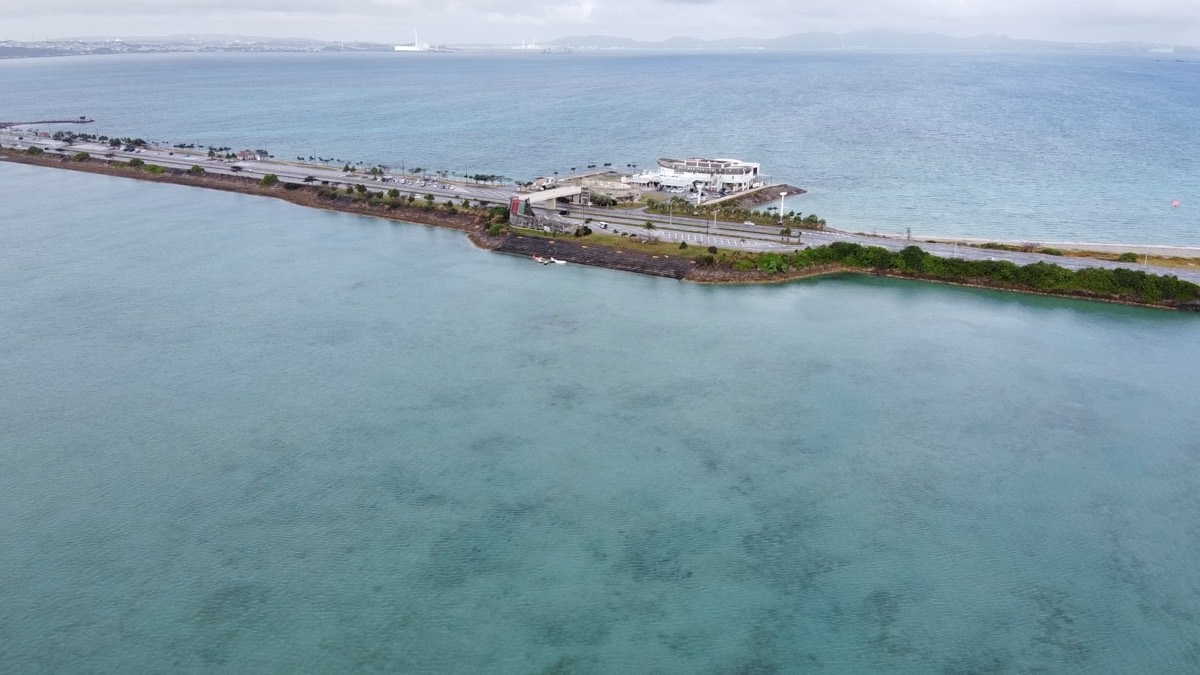
Aerial view of the Kaichu Doro causeway with Ayahashikan standing halfway along it, sea on both sides
Sea Stations #18

Ayahashi,
the beautiful bridge

Not a roadside station. It stands halfway along a 4.7 km road built across the shallows, with water on both sides of the car park.

Uruma CityBuilt 20029:00–17:30Free museum upstairs
Free museum, free parkingclosed Mondays · 35 spaces at the building
What's upstairs

In short

three things to know before you drive out to sea
01

A sea station, not a roadside one

Uruma City calls this an umi-no-eki — a sea station — rather than a michi-no-eki, and the building is designed around that: it stands on the causeway with water on both sides. It isn't part of the national roadside-station scheme.

02

The road isn't a bridge

The Kaichu Doro is 4.7 km of causeway built up from the shallows, opened in 1972 and widened to four lanes in 1999. It's free, and it's why the car park has sea on both sides.

03

Free museum, closed Mondays

The second floor is Uruma City's Museum of Marine Culture — free entry, and the place that explains how the road got built. It closes Mondays; the shop below doesn't.

Most of the good views in Okinawa require a walk, a ticket or a climb. This one requires parking the car. Ayahashikan stands in the middle of the sea, and the building is shaped like a ship because of it.

The Kaichu Doro

A road across
the shallows

The name means "sea-middle road", and it's exactly that: an embankment raised through shallow water rather than a bridge on piers. It opened in April 1972 — the year Okinawa returned to Japan — after years of campaigning by islanders who until then depended on boats and low tide.

Length

4.7 kmPrefectural Route 10, free to drive, two lanes until it was widened to four in 1999.

What it connects

4 islandsHenza, Hamahiga, Miyagi and Ikei — reachable by car, no ferry, from the main island.

Ayahashi means

Beautiful bridgeAnd the building is shaped after a maran-sen, the Ryukyuan trading ship.

The beach alongside is shallow with little rip current, which is why windsurfers use it. Downstairs there's a fresh fish counter, local snacks — mozuku seaweed tempura, jūshī rice balls — and Okinawan soft serve, plus a restaurant and souvenirs. Payment is easy here by Okinawan standards: cards and most electronic money are accepted.

Second floor

Free, and
worth the stairs

Uruma City's Museum of Marine Culture occupies the upper floor: the history and folk life of the Yokatsu peninsula, models of the maran-sen trading ships and how they were built, and — the part that makes the whole stop cohere — an exhibit on the construction of the causeway you just drove in on.

Free admission. Open 9:00–17:00 with last entry at 16:30, closed Mondays (or the following day when Monday is a holiday) and from 29 December to 3 January. Note that those hours are shorter than the building's — arrive before 16:30.

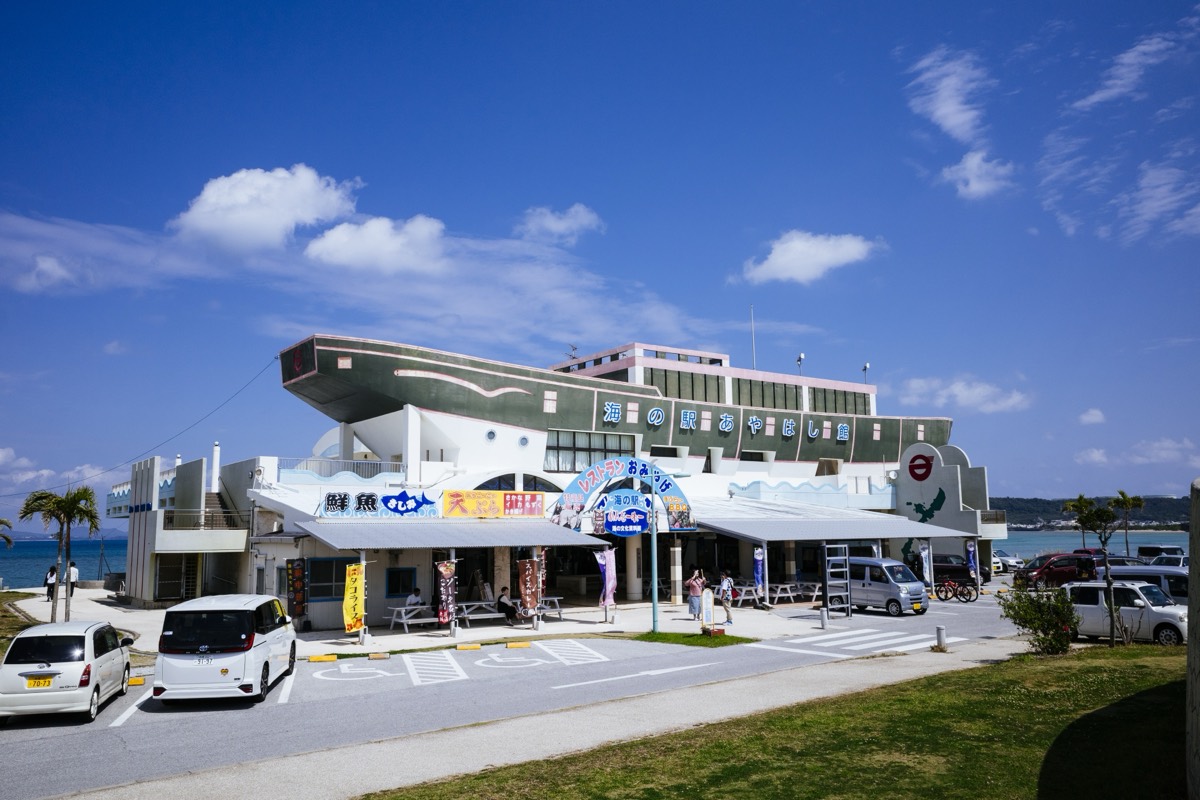
The ship-shaped exterior of Umi-no-Eki Ayahashikan seen from the car park
Built to look like a ship, in the middle of the sea road.
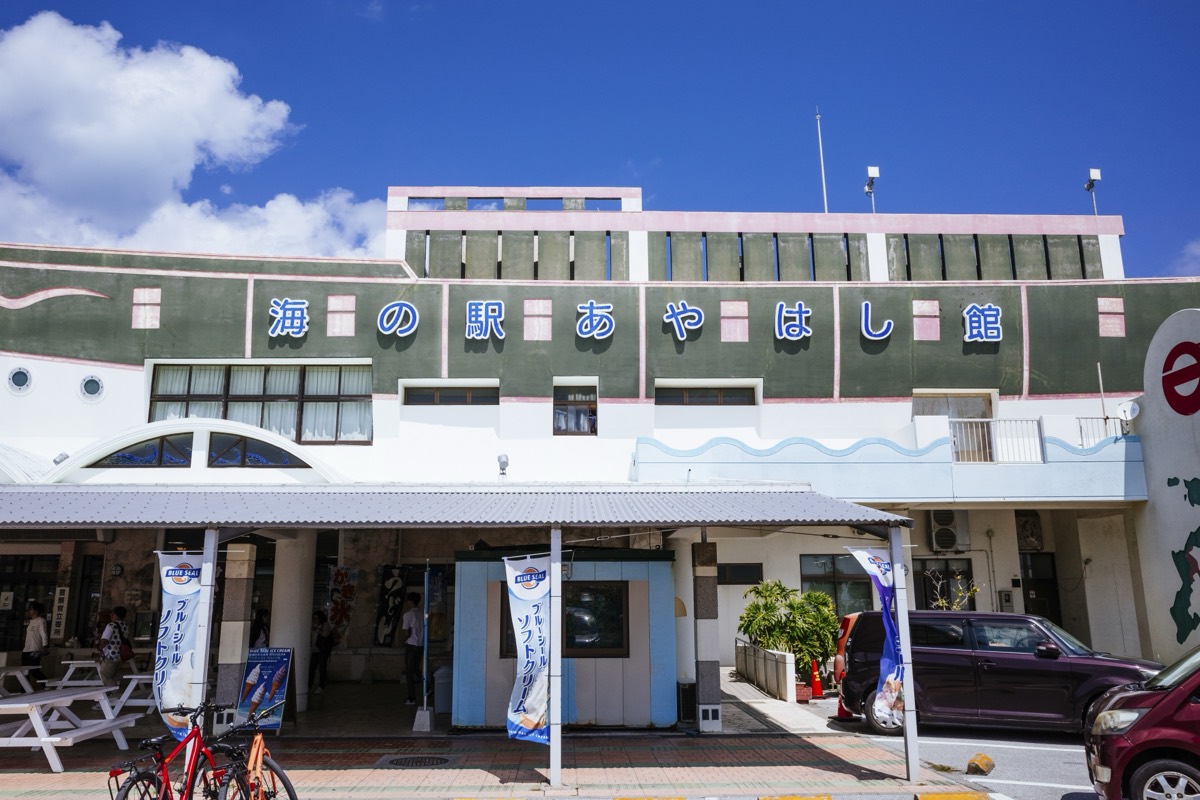
The green facade and blue sign of Umi-no-Eki Ayahashikan with soft-serve banners outside
Blue Seal and Oppa soft serve, at sea level.

One caveat about the tenants

Uruma City has managed this building directly since 2021. A long-running dispute with tenants over occupancy permits ended in a court settlement in October 2025, under which the tenants leave by the end of February 2028. The station is open and busy — but expect the shops and the restaurant to change.

We've kept this guide to what won't move: the causeway, the building, the museum and the view. For today's menu, look when you arrive.

The four islands

no ferry required, and a loop of three to four hours

Henza

Straight off the end of the causeway. An oil storage island — industrial and quiet, and the first land you touch.

Hamahiga · ~22 min

The sacred one: the tombs of Amamichu and Shirumichu, ancestors in the Ryukyuan creation story, plus Muruku Beach.

Miyagi · ~5 min

The Nuchima-su salt factory — free to tour, with salt soft serve — and the Kafu Banta cliff viewpoint.

Ikei · ~15 min

The end of the road, and the beaches: Ikei Beach and Ōdomari. About 17 km from Ayahashikan to the far tip.

Back on the mainland side, Katsuren Castle — a UNESCO World Heritage gusuku — sits above the approach road: ¥600 for adults, ¥450 for high-school students and ¥300 for primary and junior-high, with live theatre performances at weekends. Uru Marche is the place to buy food before you set out.

Getting there —
drive out to sea

By car

About an hour from Naha Airport, roughly 50 km. Take the expressway to Okinawa-kita IC, then about 30 minutes on ordinary roads to Prefectural Route 10 and out onto the causeway.

Free parking for 300 cars. The causeway itself is toll-free.

By bus — impractical

Buses toward Yakena from Naha get you into the area, and an "Ayahashikan-mae" stop does exist — but it's served by a small local operator with very limited runs.

For a place in the middle of a causeway, treat a rental car as essential.

4 Yonashiro Yahira, Uruma
Okinawa 904-2427

9:00–17:30 · museum 9:00–17:00, closed Mondays · free parking

Open in Google Maps →

Need a taxi? Here's how it works in Okinawa

You're parked in the middle of a causeway — the least walkable spot in this series. Three ways to summon a taxi:

Use an app. GO — Japan's main taxi app — works in Okinawa with an English interface. DiDi and Uber cover parts of the island. Install before your trip.

Dial with +81. From a foreign phone, replace the leading 0: 098-XXX-XXXX → +81 98-XXX-XXXX. Wi-Fi calling works too.

Ask the staff — show them this:

タクシーを呼んでください

Takushī o yonde kudasai

Nearest stations from here

Ayahashikan sits at the end of a causeway, so everything else is back on the main island. Uru Marche, at the landward end, is the natural pairing.

See the whole series →

13 km · ~25 minUru Marche, Uruma — Open until eight, at the gate to the sea road and its islands.
25 km · ~45 minMichi-no-Eki Ginoza, Ginoza — A free water playground and climbing frames on the east coast.
28 km · ~45 minOnna-no-Eki Nakayukui, Onna — Ten food stalls and mango season on the resort coast.
28 km · ~50 minMichi-no-Eki Kadena, Kadena — A free deck over the air base, and an award-winning exhibit.

Practical information

Address4 Yonashiro Yahira, Uruma, Okinawa 904-2427
Phone098-978-8830 · museum 098-978-8831 (from abroad: +81 98-978-8830)
Hours9:00–17:30. Hours may vary seasonally.
Museum9:00–17:00, last entry 16:30. Free. Closed Mondays (or the next day if Monday is a holiday) and 29 December – 3 January.
ClosedThe ground floor is open year-round, apart from New Year and occasional cleaning or works.
ParkingFree — 35 spaces at the building, about 300 more at the adjoining Kaichu Road park, 5 for coaches
PaymentCards (JCB, Visa, Amex, UnionPay and others) and electronic money including transport IC, PayPay, QUICPay, Edy, nanaco and iD
AccessibilityWheelchair accessible throughout; the museum has a ramp, automatic doors, a lift, an accessible toilet, a universal changing bed and tactile paving.
TypeCalled an umi-no-eki (sea station) by Uruma City, which built it. Not a nationally registered michi-no-eki, and not on the national sea-station register either — the only Okinawan entry there is Chatan.
BuiltBuilding completed December 2002; the museum opened April 2003. Managed directly by Uruma City since March 2021.
Questions, answered

Is Ayahashikan a michi-no-eki?+

No. Uruma City calls it an umi-no-eki — a sea station — but it isn't on the national roadside-station register, and it isn't on the national sea-station register either (the only Okinawan entry there is Chatan). What matters in practice is where it stands: in the middle of the causeway, with sea on both sides.

Is the museum free?+

Yes. Uruma City's Museum of Marine Culture on the second floor is free to enter, 9:00–17:00 with last entry at 16:30. It closes on Mondays and over New Year, while the shop downstairs stays open.

Do I have to pay to drive the causeway?+

No. The Kaichu Doro is Prefectural Route 10 and free to use. It's 4.7 km long, opened in 1972 and was widened to four lanes in 1999.

How long does the island loop take?+

Allow three to four hours to drive out along the causeway, take in Miyagi's salt factory and clifftop viewpoint, visit the sacred sites on Hamahiga and reach the beaches on Ikei — about 17 km from Ayahashikan to the far end.

Sources

Uruma City Museum of Marine Culture and the city's Ayahashikan page for hours, admission and accessibility, checked August 2026 · Uruma City Tourism and Products Association · Ryukyu Shimpo (March 2025) on the tenancy dispute · 海の駅あやはし館(おきなわLovers 日本語版). We reclassified this as a sea station rather than a roadside station, added the museum's free admission and Monday closure, and corrected the expressway exit.

Every station

nearest first, from where you are now
Uru MarcheUruma · 13 km Michi-no-Eki GinozaGinoza · 25 km Onna-no-Eki NakayukuiOnna · 28 km Michi-no-Eki KadenaKadena · 28 km Michi-no-Eki KyodaNago · 29 km Happy More IchibaGinowan · 29 km Michi-no-Eki Kina BanjoYomitan · 31 km Wansaka Oura ParkNago · 34 km Haneji-no-EkiNago · 44 km Michi-no-Eki Sunrise HigashiHigashi · 45 km Minami-no-Eki YaeseYaese · 47 km Michi-no-Eki ToyosakiTomigusuku · 49 km Nakijin no Eki So-reNakijin · 50 km Michi-no-Eki ItomanItoman · 50 km Rikarika WarumiNakijin · 52 km Kouri SorahashiKouri · 56 km Michi-no-Eki OgimiOgimi · 58 km Michi-no-Eki Yui-Yui KunigamiKunigami · 68 km Yanbaru Pineapple HillKunigami · 69 km