A roadside station with no shop
No market, no food court, no souvenirs. Kina Banjo is an information point, a rest room and a piece of restored architecture, and that's the whole appeal.
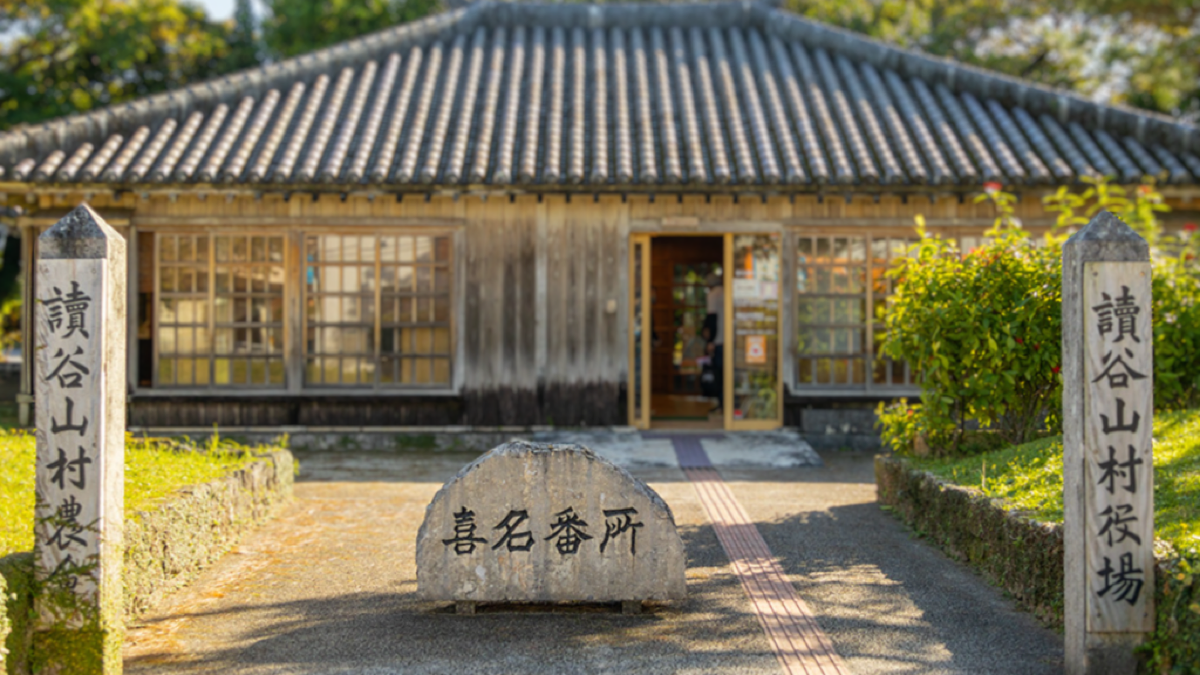
A roadside station that sells nothing. It's a rebuilt Ryukyu Kingdom district office, and Commodore Perry's men rested here in 1853.
No market, no food court, no souvenirs. Kina Banjo is an information point, a rest room and a piece of restored architecture, and that's the whole appeal.
On 3 June 1853, Commodore Perry's expedition rested at this spot on their way inland. The villagers brought them chickens, eggs and cucumbers; the expedition artist drew the scene.
Zakimi Castle, the pottery village, Cape Zanpa and Murasaki Mura are all minutes away. Start here, get advice from the guide, then go.
Every other station on this list wants to sell you something. This one just wants to explain where you are, which, on the old royal highway between Shuri and the north, turns out to be somewhere quite specific.
What a banju was
Under the Ryukyu Kingdom, the island was divided into districts called magiri, and each was administered from a banju. Despite the name, which in mainland Japanese suggests a guard post, a banju was a government office: local officials took turns in residence, collecting tribute for the royal court, organising corvée labour and running the district's affairs.
Also a post station
Relay pointBanju doubled as staging posts for people and horses on the kingdom's official highways. Kina sat on the shukumichi linking Shuri to the north.Built around
1753The original Yuntanza district office. It later became the village office, serving Yomitan until it burned in the Battle of Okinawa.Rebuilt in
2005Reconstructed with traditional Okinawan methods as part of the works around Zakimi Castle, and registered as a michi-no-eki in 2006.On 3 June 1853, Commodore Matthew Perry's exploring party stopped here on their way into the interior. The villagers gave them chickens, eggs and cucumbers, and Wilhelm Heine, the expedition's artist, made a drawing of it. Ten months later Perry would sign the treaty that reopened Japan. Standing in the doorway of a rebuilt district office in a small Okinawan village, that history feels closer than it does in most museums.
Someone is stationed here to answer questions about Yomitan: where to eat, which kiln to visit, whether the sunset at Cape Zanpa is worth the drive today. Free, and genuinely useful.
Red-clay lime flooring, timber structure, tatami. It's cool in the way old Okinawan buildings are cool, and quiet enough that local children come here to do their homework.
Photo displays on Yomitan's sights and produce, two garden pavilions outside, wireless internet, a payphone, and toilets, some of them open 24 hours.
Okinawa's largest village by population, and one of its best days out: a World Heritage castle, a working pottery village of about twenty kilns, a cape with one of the island's great sunsets, and beaches that don't belong to a hotel.
Kina Banjo sits on Route 58 in the middle of all of it. Ten minutes in here with a map and a guide will reshape your afternoon.
By car
About an hour north of Naha Airport on Route 58, the main road up the west coast. It's directly on the highway in the middle of Yomitan, easy to miss at speed, so watch for the red-tiled roof and the stone pillars.
Free parking, 39 spaces in total (35 standard, 2 large, 2 accessible), open 24 hours.
By bus: several routes
The stop is Kina, a few minutes' walk away. From Naha Bus Terminal, routes 20, 28, 29, 120 and 228 all serve it; from the Okinawa City side, route 62.
Services are infrequent, so check times before you commit, but Kina is one of the easier Yomitan stops to reach without a car.
1-2 Kina, Yomitan
Okinawa 904-0302
9:00–18:00 · closed only 29 Dec – 3 Jan · 39 free spaces · some toilets open 24 hours
Open in Google Maps →Yomitan is spread out and its sights are far apart, so a taxi between the castle, the kilns and the cape is a reasonable plan. Three ways to get one:
Use an app. GO, Japan's main taxi app, works in Okinawa with an English interface. DiDi and Uber cover parts of the island. Install before your trip.
Dial with +81. From a foreign phone, replace the leading 0: 098-XXX-XXXX → +81 98-XXX-XXXX. Wi-Fi calling works too.
Ask the staff. Show them this:
タクシーを呼んでください
Takushī o yonde kudasai
Kina Banjo has nothing to sell you, which makes it the ideal first stop before the stations that do. Two of them are within fifteen minutes.
No, and that's the point. There's no market, no restaurant and no souvenir shop. What you get is a restored Ryukyu-era district office, a tourist guide on duty, exhibition panels, toilets and somewhere quiet to sit.
Neither, despite what you may read. Japan's southernmost is Michi-no-Eki Itoman, further down the same island. Kina Banjo's real distinction is different: it's a roadside station housed in a rebuilt Ryukyu Kingdom government office.
Only 29 December to 3 January. Some sources, including Wikipedia, list Mondays, but Yomitan Village's own page, the Okinawa General Bureau and the national roadside-station association all say year-end only.
A district government office under the Ryukyu Kingdom, which also served as a staging post for travellers and horses on the royal highway. Not a guard post, despite what the characters suggest in mainland Japanese.
Sources
Yomitan Village official page, the Okinawa General Bureau and the national roadside-station association for hours, closures and parking, checked August 2026 · Naha City Museum of History digital archive for the banju system and Perry's 1853 visit · 道の駅喜名番所(おきなわLovers 日本語版). We corrected the parking breakdown and the closing days against official sources.