Cheap, and not for tourists
Mains ¥600–850, snacks ¥100–470. This is a farmers' co-operative shop on the way to the aquarium, and the prices were set for people who live here.
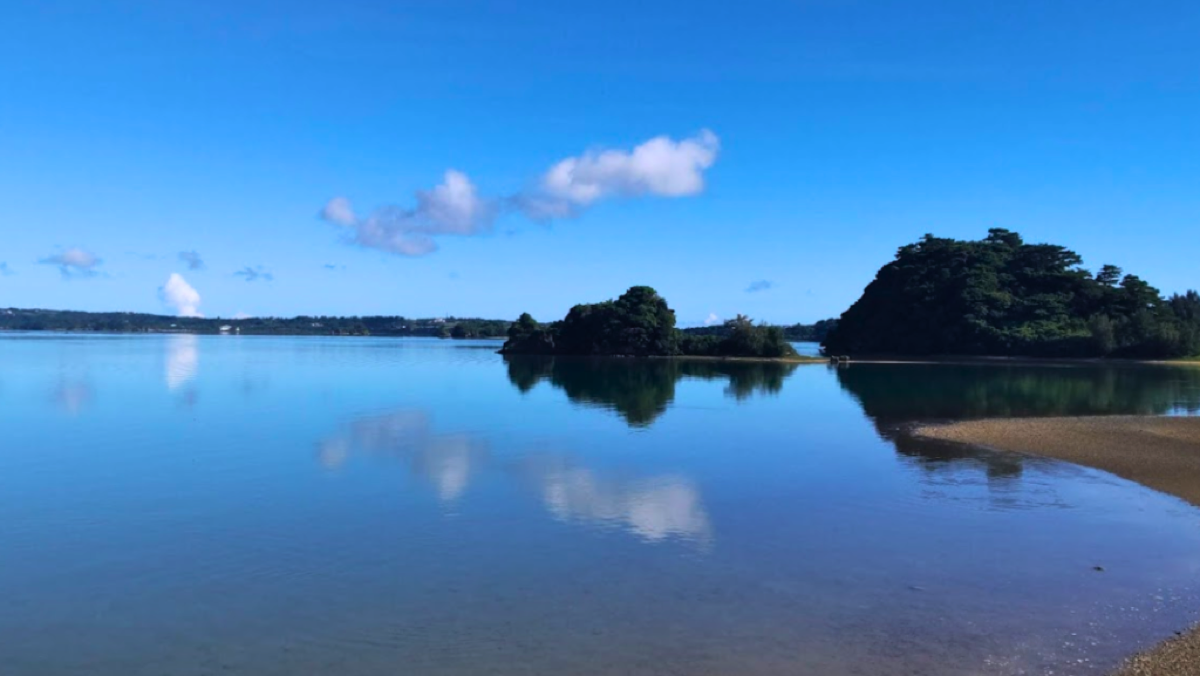
A co-op market on the road to Churaumi, where a hot half chicken costs ¥650 and the view upstairs is called Okinawa's Matsushima.
Mains ¥600–850, snacks ¥100–470. This is a farmers' co-operative shop on the way to the aquarium, and the prices were set for people who live here.
Haneji is poultry country. The eggs are local, and the birds that finish laying become the chicken in the food: half roasted at ¥650, or minced into burgers and taco rice.
Upstairs is a free rest area over the Haneji Inland Sea: 10 km² of sheltered water dotted with pine islands, which Okinawans compare to Matsushima.
Everyone drives past this one. It sits on the road between the expressway and Churaumi Aquarium, it isn't a national roadside station, and it has no marketing budget, which is exactly why the car park is full of local number plates.
Parlour Chikiran
The takeaway counter is the reason to stop. Haneji raises chickens; the eggs go to the shop and the hens that finish laying go into the food. Nothing is wasted and nothing is expensive.
Haneji chicken, half roasted
¥650
The signature order · eat it in the car park, on the sea side
"New Half" tsukune
¥180Named (in Japanese, and with no other meaning intended locally) for being half fish paste and half chicken. Eat it with Worcester sauce.Jumbo burger
¥470Minced Haneji chicken in a bun made to the shop's own spec.Pork egg onigiri
¥200Made with yanbaru eggs: the local ones, from up the road.Taco rice
¥420 / ¥250Large or small, made with the same chicken mince. Tacos ¥450.Sata andagi
¥100Plain or brown sugar, fried with local eggs.Sugarcane soft serve
¥260Vanilla or sugarcane; ¥350 with mango sauce over it.Chicken soup
¥330Tori-jiru with Haneji chicken; mugwort jūshī rice ¥220.Two sit-down kitchens share the building. Ganaha Soba does Okinawa soba daily 11:00 to 16:00: the original sōki soba at ¥800, soft-bone at ¥600, stewed pork at ¥600. Yanbaru Kuina OLI does rice bowls: agu pork at ¥700, gapao rice at ¥780, loco moco at ¥850. It closes on Wednesdays and the first and third Tuesday.
Upstairs
The second floor is just a rest area with windows, and it's the best free view in this part of Nago. The Haneji Inland Sea runs roughly 4 km north to south and 6 km across of water held between the Motobu peninsula and Yagaji Island, nowhere deeper than about 10 metres.
Because it's enclosed, it barely moves. Pine-covered islets sit in flat water and the tide leaves sandbars behind, which is why people here compare it to Matsushima on the mainland. Kayakers and fishermen use it; almost no tourists do.
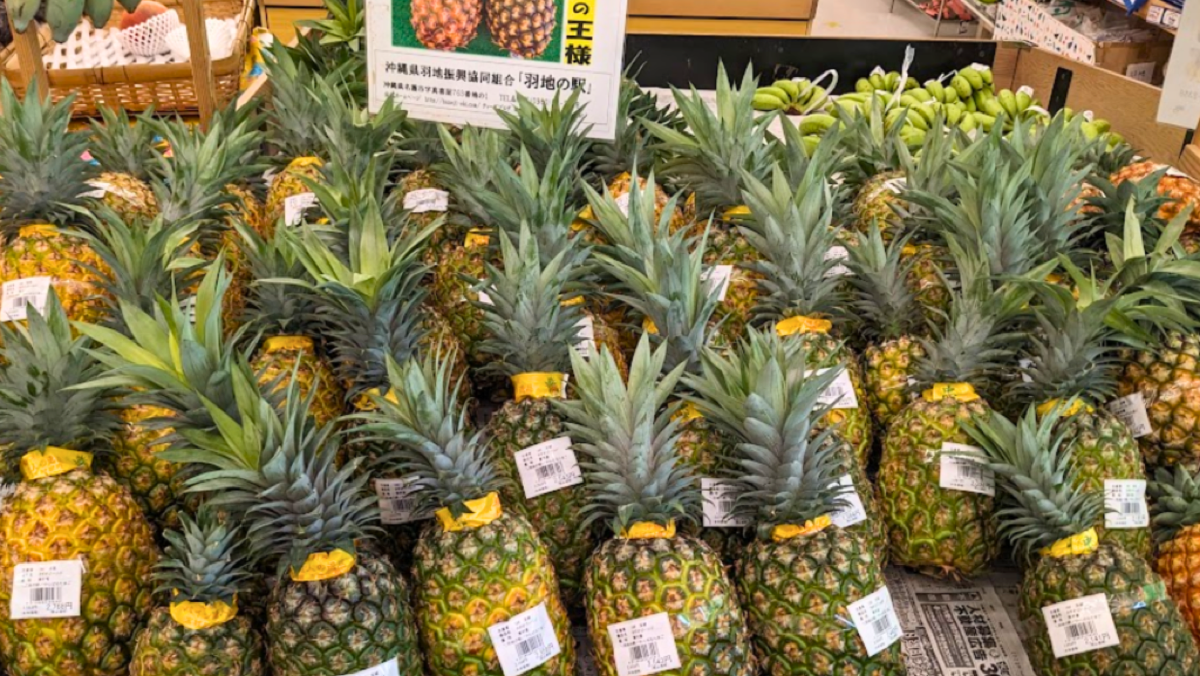
The shop's own draw: fresh local eggs at prices that make people drive here for them. Everything else in the building is built on top of that.
Produce comes not only from Haneji but from Motobu, Nakijin, Kunigami, Ogimi and Higashi. Mango is July to September; look for Gold Barrel pineapple, the premium variety.
Garden plants and saplings out front, awamori on the shelf, and (genuinely) ornamental medaka fish and fighting fish for sale. It's that kind of place.
Yanbaru Kuina OLI runs a scheme worth knowing about: children up to the third year of junior high who live in Okinawa can eat there free, one ticket a day, on the agu pork bowl or the teriyaki chicken bowl. It isn't advertised to visitors and it isn't for us, but it tells you what kind of building this is.
Okinawa has ten nationally registered roadside stations and this isn't one. Haneji-no-Eki is run by the Okinawa Haneji Development Co-operative, which opened it in May 2015.
The practical effect: no tour buses, no queue, and a shop that behaves like a shop. Free parking, 32 spaces, and toilets.
Parlour Chikiran publishes every price on the board above the counter. These are the figures as of August 2026. The kitchen closes before the shop does, so lunch is safer than a late afternoon stop.
By car
About 1 hour 30 minutes from Naha Airport by expressway: north to Kyoda IC, then Route 58 toward Nago and on along the inland sea. Roughly 15 minutes from central Nago.
Mapcode 485 454 242 if your rental car's navigation takes them. Free parking: 29 standard, 2 accessible, 1 large.
By bus: not really
There's no direct bus from Nago Bus Terminal to Haneji-no-Eki. A rental car or taxi is the realistic option.
The upside: it sits directly on the drive between the expressway and Churaumi Aquarium, so it costs you almost no detour.
763-1 Makiya, Nago
Okinawa 905-1143
9:30–18:00 · open year-round · free parking, 32 spaces · Mapcode 485 454 242
Open in Google Maps →North of Nago there are no street taxis, and a foreign SIM often can't dial a Japanese number. Three ways that work:
Use an app. GO, Japan's main taxi app, works in Okinawa with an English interface. DiDi and Uber cover parts of the island. Install before your trip.
Dial with +81. From a foreign phone, replace the leading 0: 0980-XX-XXXX → +81 980-XX-XXXX. Wi-Fi calling works too.
Ask the staff. Show them this:
タクシーを呼んでください
Takushī o yonde kudasai
Stuck somewhere else? Walk into the nearest roadside station or supermarket and ask the staff. Plenty of older locals here don't drive, so staff are used to calling taxis for customers, and some shops keep a free phone that goes straight to a taxi company. Don't rely on the numbers printed on signs and flyers: they almost never show the +81 form, and some leave out the area code (098 or 0980) altogether.
Haneji sits on the line between the expressway and the aquarium: the busiest tourist road in the north, and the cheapest lunch on it.
No. Okinawa has ten nationally registered roadside stations and this isn't one of them. It's run by the local farmers' co-operative and opened in May 2015. Which is why tour buses skip it and the prices stayed local.
The half roast chicken at ¥650, and a ¥180 'New Half' tsukune: half fish paste, half chicken, eaten with Worcester sauce. If you want a proper sit-down meal, Ganaha Soba's original sōki soba is ¥800.
The Haneji Inland Sea: about 10 km² of sheltered water between the Motobu peninsula and Yagaji Island, dotted with pine islets. Locals call it Okinawa's Matsushima. The second-floor rest area is free.
Not directly. There's no bus from Nago Bus Terminal to the station. You'll need a rental car or a taxi, though it's barely a detour from the main road to Churaumi Aquarium.
Sources
Haneji-no-Eki official site for hours, tenants and every price quoted here, checked August 2026 · Nago City Tourism Association for facilities and payment · 羽地の駅(おきなわLovers 日本語版). We corrected the driving directions (the correct exit is Kyoda IC, not Nago) and dropped the claim that taro is a local speciality, which we could not verify.