San-A
The biggest operator in the prefecture, and the default. Runs everything from neighbourhood food halls to full shopping centres including PARCO CITY. If you only go into one supermarket here, it will probably be this one by accident.
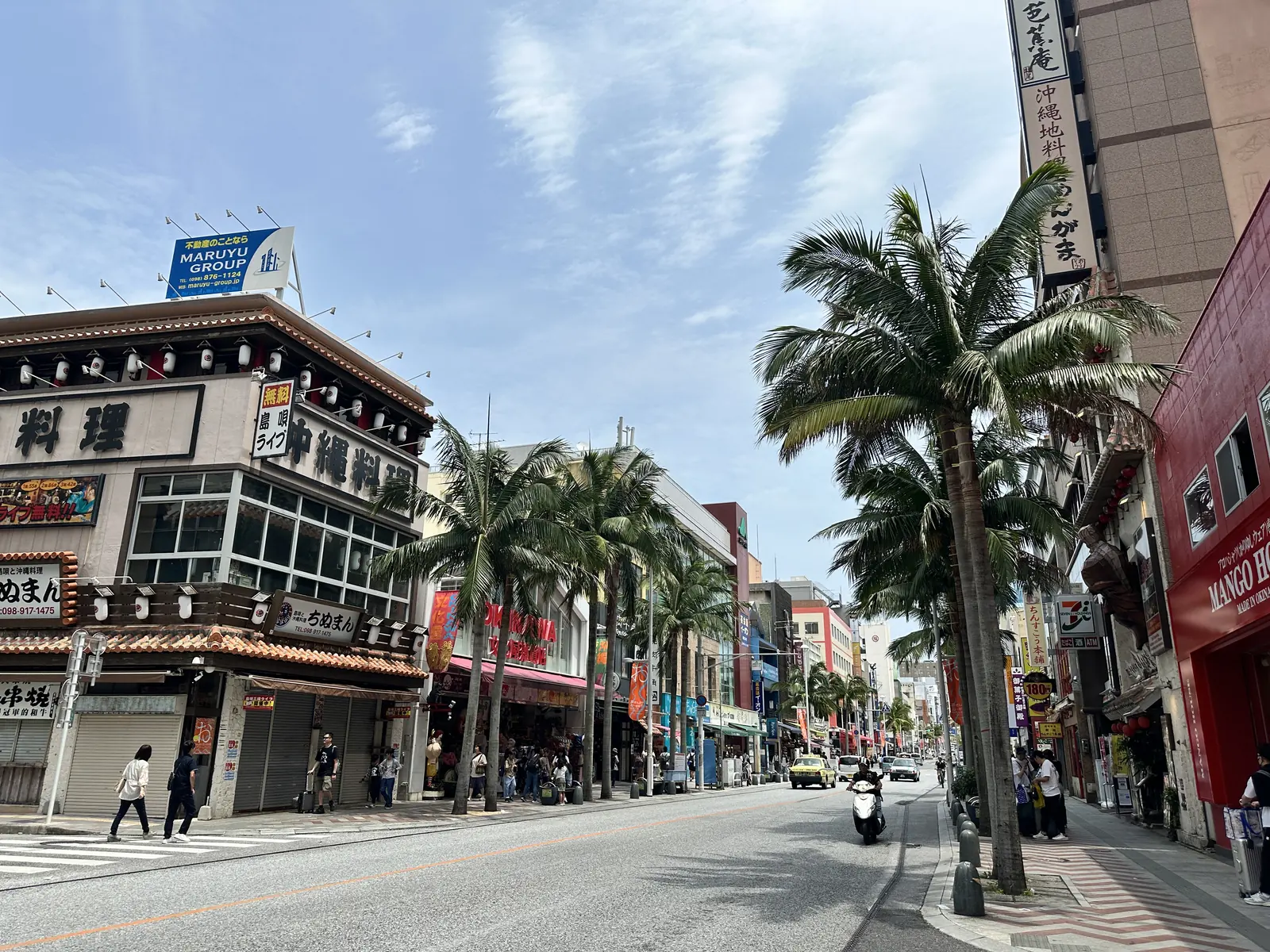
Visitors are pointed at the two big shopping centres. The interesting building is the ordinary supermarket in the middle of a town, and it is open at hours the mainland is not.
A supermarket is the cheapest interesting thing you can do in Okinawa.
Not because of the prices, though those help. Because the shelves here do not match the shelves anywhere else in Japan: tinned pork stacked by the metre, root beer, sea grapes in the chilled section, purple sweet potato in everything, and a bakery running on an American recipe book from the 1950s.
There are two things worth understanding before you go. The first is the clock. Okinawa opens earlier and closes later than the mainland, and a couple of the useful facts about that are actively misleading if you only half-know them.
The second is that "San-A" and "AEON" each describe about four different sizes of building, and the one visitors get sent to is the least interesting of them.
The biggest operator in the prefecture, and the default. Runs everything from neighbourhood food halls to full shopping centres including PARCO CITY. If you only go into one supermarket here, it will probably be this one by accident.
58 Town Plaza stores. Moved 55 of them to a 7:00 opening, two hours earlier than before, trading until 23:00. The one to know if you are driving somewhere at dawn.
Around twenty branches, famous for trading 24 hours and for staying open through typhoons. Its slogan is a clock that never stops. See the warning below about the newer stores.
The AEON group's supermarket arm, run locally by AEON Ryukyu. Many branches trade 24 hours, including Makishi in Naha, which is the closest all-night option to Kokusai-dori.
The supermarket side of Okinawa's only department store group. Urban, tidier, generally 9:00–24:00. The department store's own food hall in Naha is a different proposition again, closer to a Tokyo depachika.
Founded 1956, named after the founder's nickname from his years working on a US base. Cakes, bakery, deli and imported groceries in an American idiom. About twenty branches. There is no mainland equivalent. This one is worth a detour.
San-A, Kanehide, Union and Ryubo are the four that locals argue about. MaxValu is the national chain with a local operator, and Jimmy's is the outlier that exists because of the bases.
This is the thing that confuses visitors most, and no English guide explains it. San-A's own store-development guidelines divide its shops into four formats, and the gap between the smallest and the largest is enormous: a corner food shop at one end, a 250-shop mall at the other.
| Format | What it actually is | Examples |
|---|---|---|
| V21 food store | A neighbourhood food shop. Groceries and nothing else. This is the bottom of the ladder and the most ordinary. | V21 branches, plus small stores named after their district |
| Food hall + drugstore + restaurant | The small composite. A supermarket with a chemist and somewhere to eat bolted on. | Itarashiki, Kiyuna, Chatan Hamagawa, Nakagusuku, Mekaru (opened 2026) |
| Neighbourhood centre | Food hall, clothing hall, electronics, a handful of speciality shops, around a flat car park. The everyday hub for one town. This is the tier worth walking into. | Most of the "City" and "Town" stores. Owan City in Yomitan is the shape of it: food hall, clothing hall, an Edion electronics store and a Chinese restaurant off the same car park. |
| Wide-area centre | The regional flagship. Food, clothing, Edion, Muji, restaurants, dozens of speciality shops. | Naha Main Place, Gushikawa Main City |
Currently trading under a "City" name: Ishikawa, Ishigaki, Owan, Kyozuka, Ginowan Convention, Gushikawa Main, Shiozaki, Tsukazan, Tomigusuku Wing, Nishihara, Tamata, Miyakojima, Yaese, Yokatsu, plus Urasoe West Coast PARCO CITY, which is a different animal entirely.
Other large stores drop the "City" altogether: Naha Main Place, Hanby Town, Akamichi Shopping Town, Agarie Shopping Town, Nakanomachi Town, Shopping Town Miyako.
Two closures worth knowing, because older English pages still list them: Oyama City closed in 2024, and Machinato City closed in 2025.
Shops, including 94 that were the brand's first in Okinawa. A joint venture between San-A and PARCO, opened June 2019 on the Urasoe coast, second only to AEON MALL Rycom in retail floor area. This is a day out, not a shop. The guide →
Shops across about 22,197 m² as of its 2025 refit: food hall, clothing hall, Edion, Muji, restaurants. "Main" marks it as the flagship for the central region rather than a separate format.
So the ladder runs: V21 for the neighbourhood, City and Town for the municipality, Main City and Main Place for the region, PARCO CITY for the whole island and its visitors.
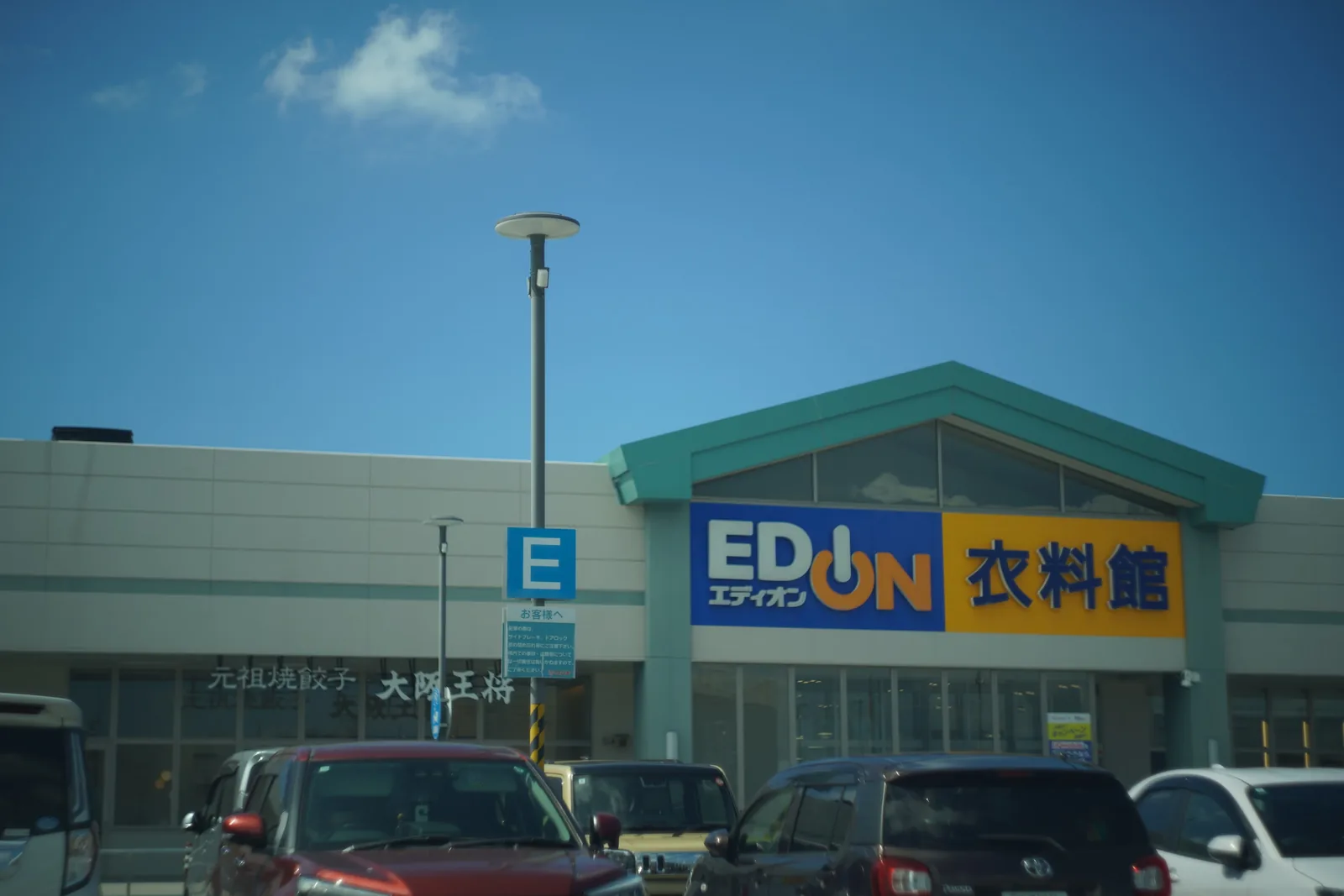
An ordinary supermarket with an ordinary name, sitting in a village or a suburb. Often a MaxValu. This is the tier visitors never get told about.
The proper shopping centre: several floors, speciality tenants, a food court. A regional destination rather than a weekly shop.
The largest retail floor in the prefecture, with an aquarium in the atrium and the only Pokemon Center in Okinawa. The full guide →
Every guide sends visitors to PARCO CITY and Rycom, and both are worth a rainy afternoon. But they are malls, and you have malls at home. What you do not have at home is the middle of the ladder: the plain San-A or AEON in the middle of a town, the one people actually shop at on a Tuesday.
From the outside it is the most generic building imaginable, the same supermarket that exists in every country on earth. That is exactly what makes it work. The format is familiar enough that you can read it instantly, so the things that are not familiar jump straight out of the shelves at you.
Pork in tins, taking up the space cereal would occupy elsewhere. Sea grapes sold like salad. Bitter melon in a pile. Purple sweet potato worked into every sweet on the aisle. Root beer next to the tea. A shelf of shikuwasa bottles where a mainland store would keep lemon squash, and awamori where it would keep sake. It is a whole food culture laid out in a building you already know how to walk around, at prices nobody set for tourists.
It costs nothing to walk in, and it is the closest thing to an unstaged version of the island you will find in an hour.
Machigwa is the Okinawan word for a market or a shopping street, and it describes the layer underneath every chain on this page: individual shops, run by their owners, often by people well into their seventies and eighties.
The best-known example grew out of the black market that formed in Naha after the Second World War and became the First Makishi Public Market, the island's kitchen. Around it, a whole district of small shops assembled itself without anyone planning it. Because almost everyone selling was a woman, it was known as anmā no machi, the mothers' market.
There is no English signage worth speaking of, prices are sometimes not marked, and nothing about it is arranged for visitors. That is the appeal. A chain supermarket shows you what Okinawa eats; the machigwa shows you who sells it. The conversation you have with an obā behind a table of vegetables is a different order of encounter from a checkout.
Bring cash and small notes. Do not expect card readers, and do not photograph people or their stock without asking.
Worth doing in that order if you have the time. Each step down gets less convenient and more specific to this island.
Union's whole identity is being open when nothing else is. But the company has been rolling out a second format, Union Sukara, and those stores keep ordinary hours. When the Sukara branch at Oroku opened, the local paper ran the line straight: it's a Union, but it isn't open 24 hours.
This matters because the most convenient one for visitors is a Sukara. Union Sukara Kokusai-dori opened in June 2025 on the old Lopia site, right where tourists are, and it shuts at 23:00. If you want a supermarket at two in the morning in Naha, you want MaxValu Makishi, not the Union on the main street.
The classic branches trade around the clock and have a reputation for opening through weather that closes everything else. Not every branch and not the Sukara stores. Check the individual shop before relying on it at 3am.
Makishi in Naha, Iso in Urasoe, Tomigusuku, Awase in Okinawa City, Itoman-kita, Yamazato, Yaese, Chibana, Shintoshin-Mekaru and Yaima on Ishigaki are all listed as 24-hour.
55 stores open at 7:00 and run to 23:00. The change was made for customers and staff alike, and it makes Kanehide the practical answer for an early start north.
Ryubo generally to 24:00 (Mihara opens at 7:00), Sukara to 23:00, Jimmy's Oyama to 21:00 with no closing days.
| Chain | Typical hours | Scale |
|---|---|---|
| Union | 24 hours (original format) | ~20 trading branches |
| Union Sukara | 9:00–23:00 (not 24h) | New format |
| MaxValu | 24 hours at many branches | AEON Ryukyu |
| Kanehide | 7:00–23:00 | 58 Town Plaza |
| Ryubo Store | 9:00–24:00 | Urban branches |
| San-A | Varies; food halls to 23:00 | Largest operator |
| Jimmy's | 9:00–21:00 (Oyama) | ~20 branches |
English guides to Okinawan supermarkets tend to skip this, and the reason is that there is nothing good to report. None of the main local chains advertises tax-free service on its official website, and the individual branch pages do not list it either. That includes the 24-hour MaxValu at Makishi, whose page names its ATM and its bill-payment service but says nothing about tax free.
That is not an oversight on their part. Registering as a tax-free operator is administrative work aimed at a customer base that neighbourhood supermarkets here mostly do not have.
So treat the two activities as separate. Buy food, drink and everyday things at the supermarket and pay the tax. If you want the tax back, do that shopping at a mall or a Don Quijote, where the counters exist. AEON MALL Okinawa Rycom has a ground-floor tax-free counter →

The same caution applies to farm markets and roadside stations, which are a genuinely better place to buy fruit and vegetables but are cash-oriented and are almost never registered tax-free shops. All 20 roadside stations →
What supermarkets are unambiguously good for is the boxed sweets: the same chinsuko and beni-imo tart boxes sold at the airport, at grocery prices. What to buy for people back home →
Card acceptance has improved across all these chains, but the further you get from a city the more cash-first things become. Keep notes on you outside Naha and the central corridor.
Union runs its own UNICARD electronic money, and the AEON group has its own ecosystem at MaxValu. Neither is worth signing up for on a short trip.
MaxValu Makishi has an AEON Bank ATM in-store, which takes foreign cards and is open whenever the shop is. At Makishi, that is always.
Yes. Union's original-format branches and a number of MaxValu stores, including Makishi in Naha, Iso in Urasoe, Tomigusuku and Awase. The catch is that Union's newer Sukara stores are not 24-hour despite the name.
MaxValu Makishi, at 2-10-1 Makishi, open 24 hours with 93 parking spaces and an AEON Bank ATM. Union Sukara Kokusai-dori is also close but closes at 23:00.
Earlier than you would expect. Kanehide moved 55 stores to a 7:00 start, Ryubo's Mihara branch also opens at 7:00, and the 24-hour Union and MaxValu branches never close in the first place.
Realistically, no. None of the main local chains promotes tax-free service and the branch pages do not list it. Do that shopping at a mall or Don Quijote instead.
San-A and Kanehide carry the widest local range simply because they have the most stores and the deepest local supply. Jimmy's is the one to visit for a different reason. It sells the American side of Okinawan food culture, which no mainland chain does. For specific products, note that supermarket shelf prices are often higher than the maker's own: yukishio is a good example.
No. It is a joint venture between San-A and PARCO with around 250 shops, second only to AEON MALL Rycom in retail floor area. An ordinary San-A is one of four smaller formats: a V21 food store, a small composite with a drugstore, a neighbourhood centre (most of the "City" and "Town" shops), or a wide-area flagship like Naha Main Place and Gushikawa Main City. The word "City" in a name is not a size.
The Okinawan word for a market or shopping street. It is the layer below the chains: individual shops run by their owners, often elderly, with cash prices and no English. The Naha example grew out of the post-war black market into the First Makishi Public Market; because the sellers were almost all women it was called the mothers' market.
Most do. Union's reputation is built partly on staying open through weather that shuts everything else, which is why islanders talk about it the way they do. Do not treat that as a guarantee for any particular branch on any particular day.