Waiver, ¥1,100 per 24h
Removes your share of the repair cost. The NOC still applies on top of it.
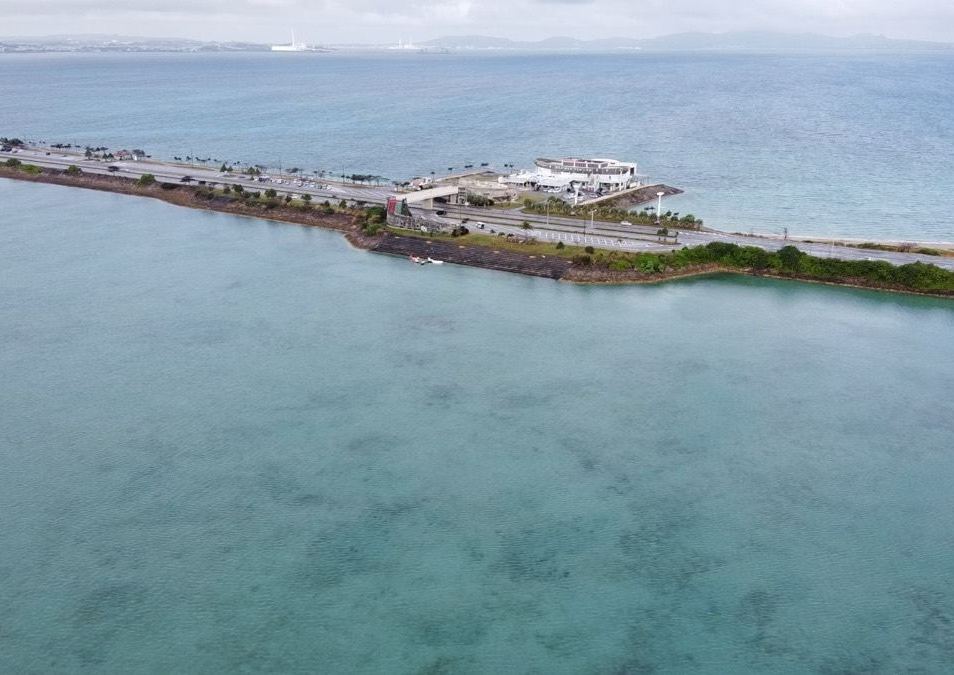
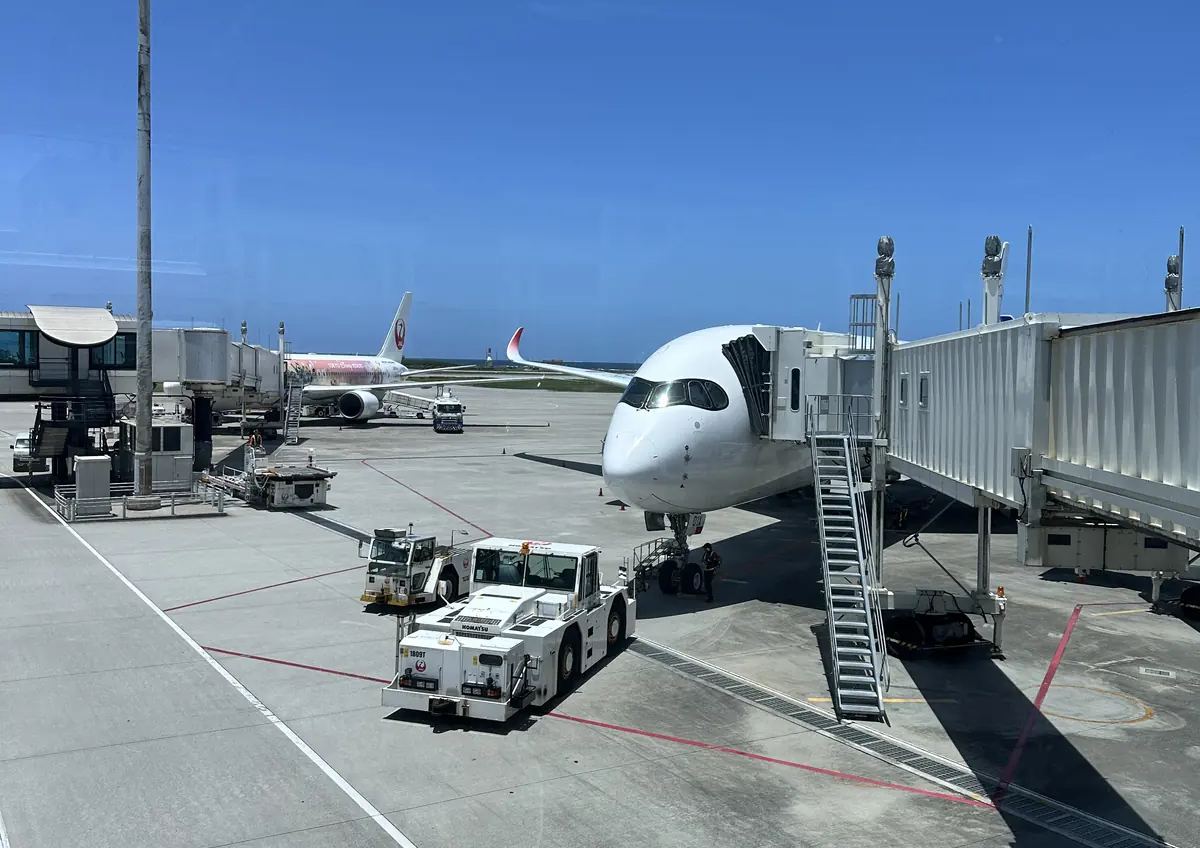
Naha Airport has no rental desks inside the building. You walk out, board a shuttle bus, and do the paperwork at a depot several minutes away. In August that can take an hour before you are driving.
Almost everything worth seeing in Okinawa assumes you have a car. The bus network covers Naha and the west coast and very little else, so the rental booking decides more about your trip than the hotel does.
Prices here move by season and by how early you book, sometimes close to double. So this guide does not compare rates. It covers the things that do not move: what documents let you drive, what happens at the airport, which insurance actually covers you, and the five things about Okinawan roads that catch people out.
One figure to hold on to before the detail. The waiver most people buy at the counter does not cover the charge most people end up paying. That gap is between ¥20,000 and ¥50,000, and closing it costs ¥550 a day.
Japan recognises the International Driving Permit issued under the 1949 Geneva Convention, and only that one. If your permit was issued under the 1968 Vienna Convention, it is not valid here, and no rental company will hand over a key. Check which convention your issuing country used before you pay for the permit.
The permit never travels alone. You carry your original home licence and your passport with it, because the passport is what shows the date you entered the country. The permit is good for one year from that date and cannot be renewed inside Japan.
Taiwan works differently, and this is the part that goes wrong most often. Taiwan is not party to the 1949 convention, so a Taiwanese driver does not use an IDP at all. Instead you carry your Taiwanese licence together with an official Japanese translation of it. Switzerland, Germany, France, Belgium and Monaco use the same translation route. Everyone else on the list below uses the permit.
| Where your licence is from | What you need | Also carry |
|---|---|---|
| UK, Ireland, Australia, New Zealand, Canada, Singapore, Hong Kong, South Korea, Thailand, Malaysia and other 1949 Geneva states | 1949 Geneva IDP, obtained in your own country before you travel | Home licence, passport |
| Taiwan | An official Japanese translation of your licence. No IDP. JAF issues these, and so do the Taipei Economic and Cultural Representative Offices | Home licence, passport |
| Switzerland, Germany, France, Belgium, Monaco | Japanese translation, as above | Home licence, passport |
| United States | 1949 Geneva IDP. AAA and AATA issue them; they are not sold online by third parties | Home licence, passport |
| Mainland China | Not able to drive on a Chinese licence. China is not party to the 1949 convention and is not on the translation list | — |
There is no rental desk inside Naha Airport. Every company works the same way: a shuttle out to a depot, and the contract is signed there. Visitors who have rented at other Japanese airports are often expecting a counter in the arrivals hall, and there is not one.
Do not schedule anything for the first hour after you land. A first-day plan built around driving straight to the aquarium tends to collapse in the queue at the depot.
The return works in reverse, with a refuelling stop before it: fill the tank, hand the car back, settle the bill, then ride the shuttle to departures. Be at the depot two hours before your flight and none of that is stressful.
Shuttle frequency is one of the real differences between companies. The large chains run every ten minutes or so. Some budget operators run every twenty to thirty. If you are choosing on price, look at this line as well as the rate.
Japanese rental contracts carry two separate charges after an incident, and buying cover for one does not touch the other.
The collision damage waiver removes your share of the repair bill, which otherwise runs to between ¥50,000 and ¥100,000. The non-operation charge, always written NOC, is separate. It compensates the company for the days the car cannot be rented out while it is being fixed or cleaned. Being insured for the repair does not exempt you from the NOC.
Removes your share of the repair cost. The NOC still applies on top of it.
¥20,000 if you can drive the car back to the agreed branch. ¥50,000 if it has to be recovered, or you return it somewhere else.
The upper plan waives the repair share and the NOC, and usually tyre and wheel damage as well.
Those are Toyota Rent a Car's published figures, quoted because Toyota states the conditions and the amounts openly on its own site. Other companies price it differently and give the plans different names. The difference between the two levels is ¥550 a day. Over four days that is ¥1,650, set against a possible ¥50,000.
We do not buy the upper plan for everyday driving at home. We recommend it to every visitor without hesitation, because the risk is not the same: an unfamiliar car, on the left, on roads you are reading for the first time, usually with a schedule to keep.
Then there is distance, which the map understates. Okinawa's main island is long and thin. From the interchange nearest the airport to Kyoda, where the expressway ends, is about 65km, and everything north of that is ordinary road through towns. Naha to the aquarium is a two hour drive when nothing is wrong.
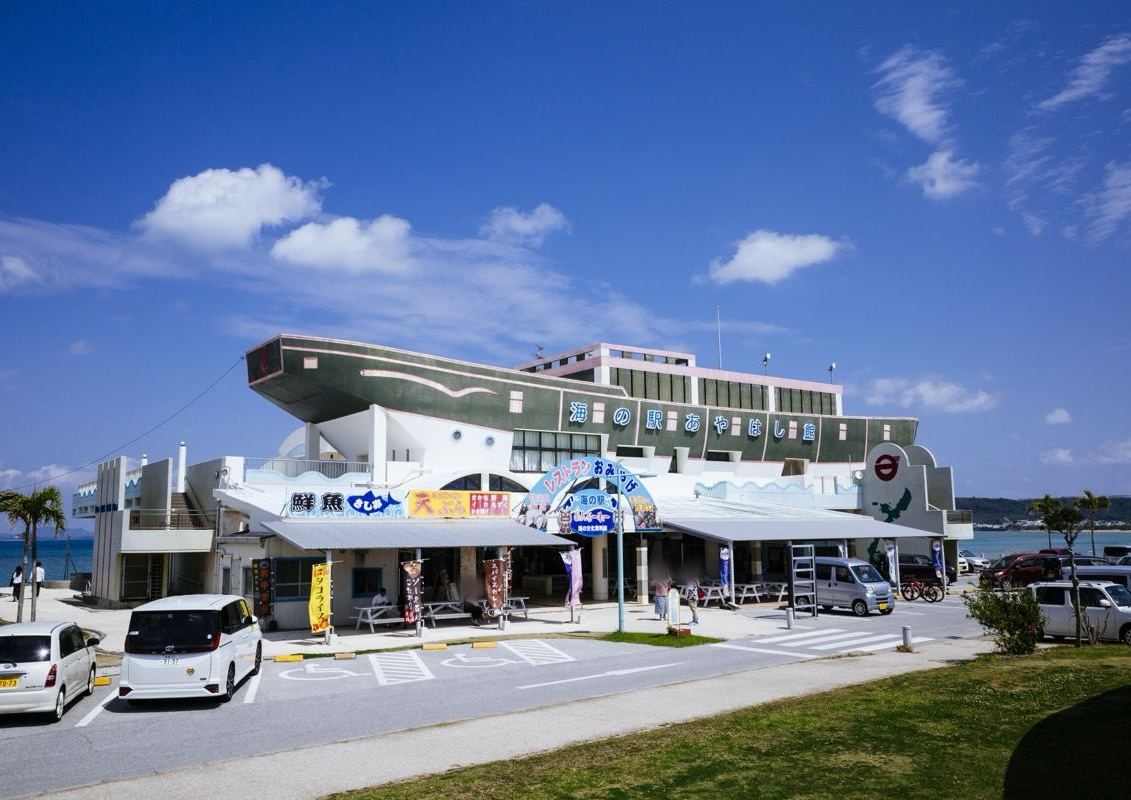
Naha itself does not move at either end of the working day. Route 58 into the city is reliably slow in the morning and out of it in the evening. Coming back from the north, either start before the afternoon builds, or stop at a roadside station and let it pass. The roadside stations exist for exactly this.
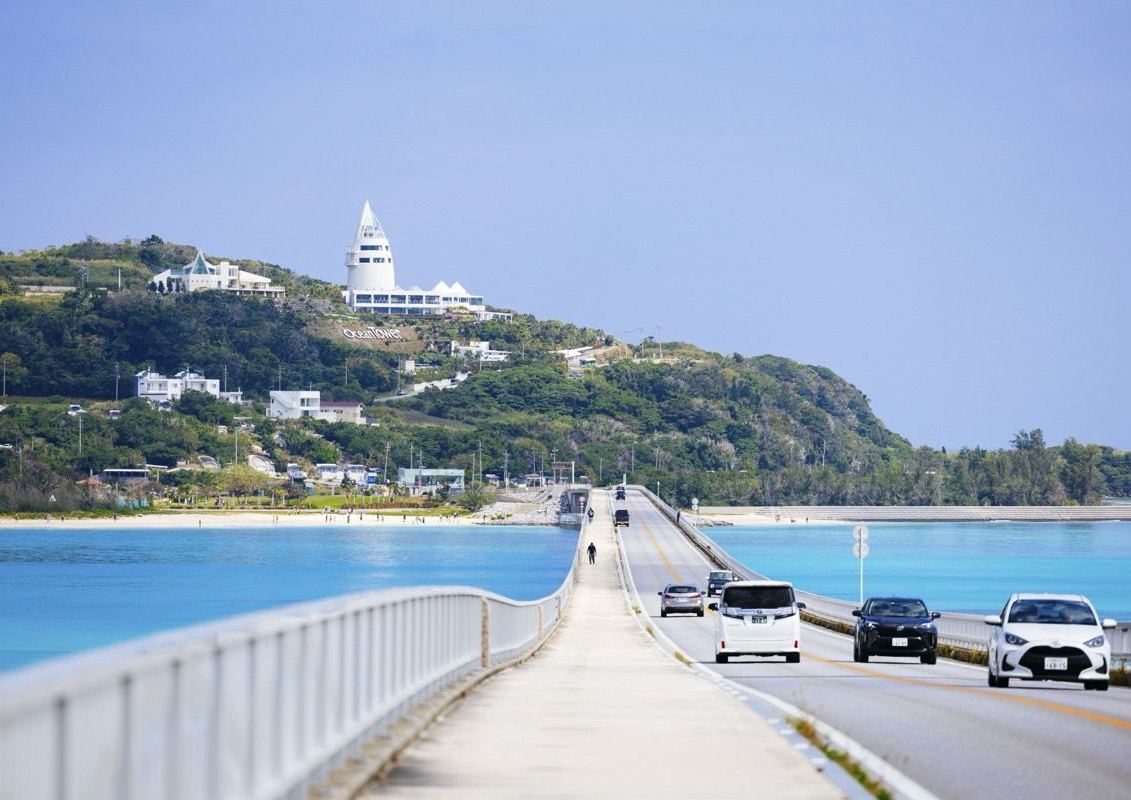
The rewards are on the small roads. The Kaichu-Doro causeway runs 4.7km across the sea to a set of flat islands, and the Kouri Bridge is 1,960m and free to cross. Neither is reachable any other way.
Rates move by season and by booking date, so a comparison table would be wrong within weeks. What follows is what to look at on each company's booking screen. Compare the actual prices yourself, same dates and same class, on the day you book.
Only Toyota has figures quoted here, because it is the one that publishes its insurance conditions and amounts openly. That is not a statement about anyone else being dearer.
Major. Insurance conditions and prices are published in full, so you can decide before you arrive at the depot.
Waiver ¥1,100 per 24h. The upper plan, which includes the NOC, ¥1,650.
Major. Depots at the airport and around the island, and the booking flow is the same as on the mainland.
Check: shuttle frequency, option pricing, whether NOC cover costs extra.
Major. Campaign pricing moves more than the others; the same dates can quote differently a week apart.
Check: early-booking deadline, upper insurance tier, one-way returns.
Major. Cover is split into two tiers, and the upper one does not automatically include the NOC.
Check: whether the upper tier waives the NOC, and whether you can specify a model.
Major. Membership scheme, which is useful if you already use it elsewhere in Japan.
Check: the per-day rate for extending, member discount, depot location.
Budget. Genuinely cheaper headline rates, with older cars and depots that are further out.
Check: distance from the airport, shuttle frequency, the age of the car.
Budget. Many branches in Okinawa and an airport shuttle, so the easiest of the budget options to use.
Check: whether your branch allows one-way returns, shuttle hours, what the cover includes.
If you go budget, weigh those three things rather than the rate alone. The island is two and a half hours end to end and some of the driving is mountain road, so the cost of a problem rises with how tight your schedule is.
For two days around Naha, budget is usually fine. For a week of long days to the north, the difference in what you are buying is real.
In Golden Week, July to September and the New Year period, cars do not get expensive so much as run out. Book the car straight after the flights, before the hotel.
In January, February, June and November you can book late and pay less. Which month that should be is a separate question.
Almost every contract is full-to-full. Fill up near the depot and show the receipt. The stations closest to the airport queue with returning cars, so use one a town earlier.
Skip it and you pay the company's own rate per litre, which is above the pump price.
Depots close when a storm warning is issued. A cancelled inbound flight cancels the booking, but a typhoon during your stay leaves you holding a car you cannot drive.
Extension terms vary by company. If you are coming between July and October, ask at the time of booking.
Not on its own. You need a 1949 Geneva Convention International Driving Permit, obtained in your own country before you travel, carried together with your home licence and passport. Permits issued under the 1968 Vienna Convention are not valid in Japan. Taiwanese, Swiss, German, French, Belgian and Monegasque licences use a different route: an official Japanese translation of the licence instead of a permit. An IDP cannot be issued after you arrive.
Your Taiwanese licence plus an official Japanese translation of it, and your passport. Taiwan is not party to the 1949 Geneva Convention, so an international permit is not the right document here. JAF issues the translation, as do the Taipei Economic and Cultural Representative Offices in Japan. It is valid for one year from the date you entered the country.
No. Leave the arrivals hall on the ground floor, cross the road, and find your company at the shuttle stands numbered 10, 11-A, 11-B and 14. Shuttles run every 10 to 20 minutes and the depots are 5 to 15 minutes away, and the paperwork happens there. In the busy months, expect more than an hour between landing and driving.
No, and this is the most common misunderstanding. The waiver removes your share of the repair cost. The NOC, the non-operation charge, compensates the company for the time the car is off the road, and it is billed separately. Toyota publishes ¥20,000 if you return the car under its own power to the agreed branch, and ¥50,000 if it has to be recovered or is returned elsewhere. Waiving both costs ¥1,650 per 24 hours against ¥1,100 for the waiver alone.
No. The Okinawa Expressway has two rest areas, Igei service area and Nakagusuku parking area, and neither sells fuel. Rapid EV charging is available. Fill the tank before you join, particularly if you are heading north.
Traffic drives on the left. Weekday rush hours bring bus lane restrictions on Route 58 and other main roads. Parts of central Naha have a centre line that moves by time of day. On Sundays, 1,300m of Kokusai-dori is closed to cars from 12:00 to 18:00. Vehicles with Y, A or E plates are registered to US military personnel, and an accident involving one follows a different procedure.
Not inherently. Check three things rather than the headline rate: how far the depot is from the airport, how often the shuttle runs, and the age of the car. Two days around Naha on a budget booking is usually fine. A week of long drives to the north is where the difference starts to matter.